
Five Elements · 五行
Why We Need Each Other: A BaZi Theory of Connection
June 1, 2026 · 8 min read
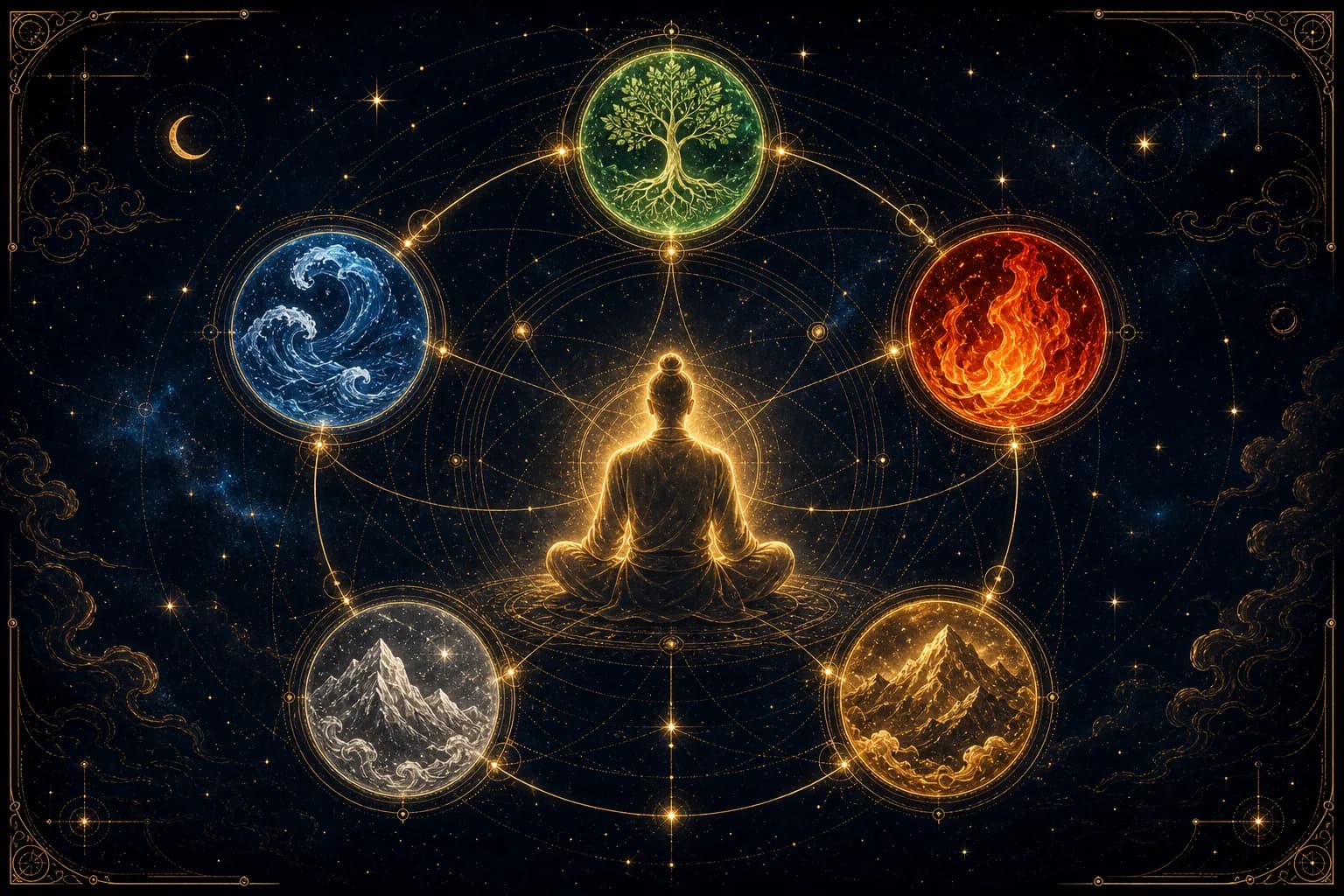
Two people are born on the same day, in the same city, the same hour. BaZi gives them the same chart — the same Day Master, the same Four Pillars, the same elemental weather at birth. On paper, the same fate.
And yet their lives diverge completely. One is steady and the other restless; one finds money easily and the other never can; one marries young and the other stays solitary. If the chart is identical, what splits them apart?
The classical answer is quietly radical: the people around them are different. And in BaZi, that isn't a soft, sentimental claim. It's structural. Your chart is incomplete by design — and the people in your life are how it gets completed.
Your chart is a single circle
Picture your birth chart as one spinning circle — a single, pure frequency. It has a shape, a rhythm, a tilt. Someone born the same moment as you traces the exact same circle. If a single circle were all there is to a life, identical charts would mean identical lives.
But no real life is a single circle. A real life is a complicated, surprising curve — full of turns nobody could read from the birth moment alone. So where does all that complexity come from?
A detour through Fourier
There's a beautiful result in mathematics — the Fourier transform — which says that any complex wave, however jagged or strange, can be built by adding up simple circles, each turning at its own steady speed. One circle alone draws a boring loop. Add a second, spinning at a different rate, and the path starts to wander. Add a few more and you can trace a signature, a heartbeat, the outline of a face.
A single circle is predictable. The sumof circles is where richness lives. Two people who start from the same first circle can end up drawing utterly different curves — because they're each adding different circles on top.
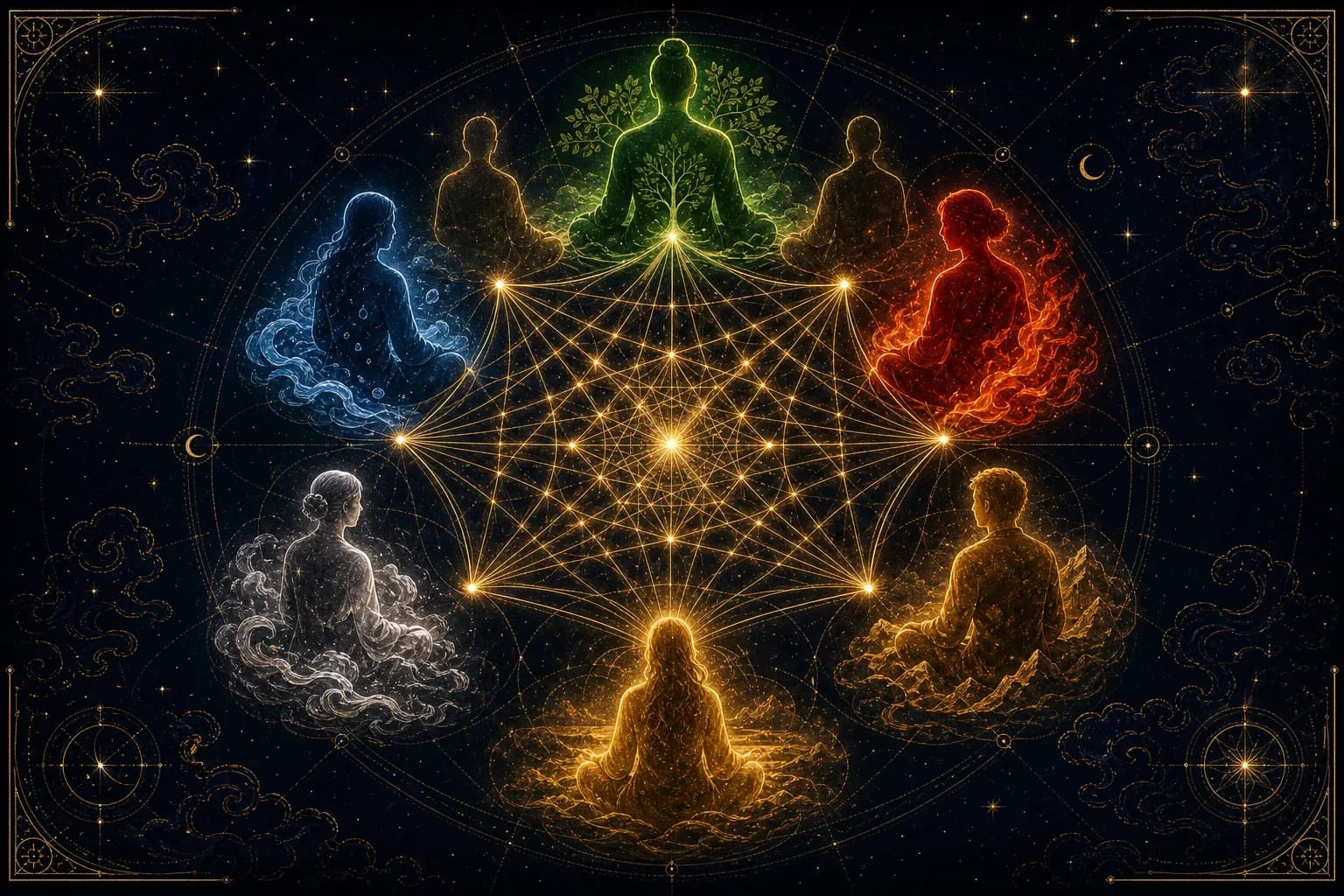
In a life, those other circles are people. Each person you're close to is another frequency added to your own — another element, turning at its own rate, bending your path.
The chart already tells you it's incomplete
Here's what makes BaZi different from a horoscope that just flatters you. Every chart carries a built-in deficiency and a built-in need. Read the balance of the Five Elements — Wood, Fire, Earth, Metal, Water — and almost no one is even. You run hot on some and thin on others. Something is always missing or running low.
That missing piece has a name: your Useful God (用神) — the single element your chart most needs to come into balance. It is, quite literally, the thing you cannot supply enough of on your own. A weak Wood person needs Water and more Wood around them; a Fire person buried under Metal and Water needs warmth they can't generate alone.
Sit with that. The chart isn't a self-contained portrait of a self-sufficient person. It names what you're missing — and therefore what you have to get from outside. The need for others is written into the structure.
People are how the missing element arrives
Everyone carries their own five-element signature. Your friend who feels like sunshine very often isFire-heavy. The steady one who grounds you tends to carry Earth. The person who makes you think runs cold and deep with Water. This isn't metaphor stretched thin — it's the same engine, read across two charts.
So when your chart is starving for Fire and a Fire-rich person walks into your life, something real happens: the element you couldn't generate is supplied from the outside. They warm the part of your chart that was cold. Spend years near them and your whole pattern shifts — not because your birth chart changed (it never does), but because the field you live inside did.
This is why the same-birthday puzzle dissolves. Two identical charts, two different circles of people, two different sets of elements being poured in daily. Of course the lives diverge. The wonder would be if they didn't.
Connection isn't optional. It's compositional.
We tend to talk about relationships as something added onto a finished self — nice to have, emotionally enriching, but ultimately decoration. BaZi suggests the opposite. You are not a finished self that then goes looking for people. You are a chart with named gaps, and the people you gather are how those gaps get filled. The composition of your life is, in part, the composition of your circle.
It reframes loneliness, too. To be isolated isn't just sad — for a chart that needs an element it lacks, isolation is a kind of nutritional deficiency. And it reframes who you keep close: the people who bring what you're missing aren't luxuries. They're the other circles your life needs to draw its real shape.
From a snapshot to a trajectory
There's one more turn. A circle of people isn't static, and neither is fate. In BaZi, your luck pillars (大运)move the background every ten years — the elemental weather of your life runs hot, then cold, then hot again. The same friend matters enormously in the decade when fate runs cold and you're starving for what they carry, and fades into the background in the decade you already have plenty.
Add a person, lose a person, and the whole curve redraws — a small change near the start, amplified across a lifetime. That's the difference between a snapshot and a trajectory, and it's why “who you spend your time with” is not a footnote to your destiny. It's a variable in it.
See your own circle's effect
Add the people closest to you and watch how their combined elements supply — or starve — the one your chart most needs. It's free, and it's the clearest way to feel this essay in your own life.